
Crab Mentality: Why Do Some People Pull Others Down Instead of Rising Together?
~ Prabhgun Kaur, Intern
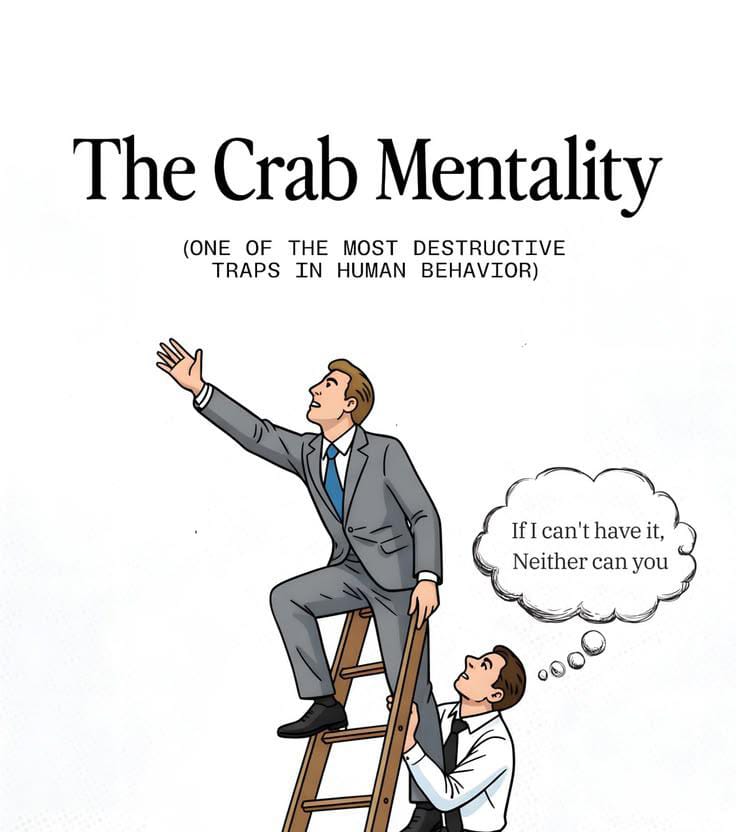
Imagine a bucket full of crabs. The interesting part is that no lid is needed to keep them inside. Whenever one crab tries to climb out, the others pull it back down. In the end, none of them escape.
This is where the term “crab mentality” comes from.
It isn’t just about crabs. It reflects a pattern of human behavior that quietly exists in schools, workplaces, friendships, families, and even on social media. It is the belief that “If I can’t have it, neither should you.” Instead of celebrating someone else’s success, people compare, criticize, discourage, or secretly hope they fail.
The saddest part? Many people don’t even realize they’re doing it.
Crab mentality usually doesn’t come from hatred. More often, it grows from fear, insecurity, and comparison.
When someone close to us achieves something we are still struggling for, it can trigger uncomfortable emotions. We may start questioning ourselves: “Why them and not me?” “Am I not good enough?” “What if they leave me behind?”
Rather than facing these feelings, some people cope by pulling others down. They gossip, discourage dreams, point out flaws, or make success seem undeserved. It becomes easier to criticize someone else’s progress than to confront our own fears.
Social media has made this mindset even stronger. Every scroll shows someone getting promoted, traveling, buying a house, getting married, or reaching another milestone. Gradually, life begins to feel like a competition instead of a personal journey.
Comparison creates pressure. Pressure creates insecurity. And insecurity often gives birth to crab mentality.
Sometimes, crab mentality is very obvious. A colleague refuses to share helpful information because they don’t want you to perform better. A friend constantly makes fun of your goals whenever you start taking them seriously. Family members may tell you that your dreams are unrealistic, not because they know you will fail, but because they fear change or have stopped believing in their own possibilities.
Other times, it is much more subtle.
Someone congratulates you with a smile but feels uncomfortable inside. They support you only until your success becomes greater than theirs. They disappear when you need encouragement but appear when you make mistakes.
This behavior can be deeply painful because it often comes from people we trust the most.
But here’s something important to remember: people who try to pull others down are often fighting battles within themselves.
Psychology suggests that individuals with low self-esteem or a fixed mindset are more likely to see another person’s success as proof of their own failure. Instead of believing that opportunities are abundant, they believe success is limited—as if someone else’s achievement leaves less room for everyone else.
This is called a scarcity mindset.
A scarcity mindset says: “If they succeed, I lose.”
A growth mindset says: “Their success shows me what is possible.”
The difference between these two beliefs can completely change how we experience life.
Think about the people who genuinely inspire you. They celebrate your victories, encourage your growth, and never make you feel guilty for succeeding. These are people who understand that another person’s light does not dim their own.
Healthy relationships are built on encouragement, not competition.
The good news is that crab mentality is not permanent. It can be unlearned.
The first step is becoming aware of your own reactions. The next time someone shares good news, notice what you feel. If jealousy appears, don’t judge yourself for it. Instead, ask, “What is this emotion trying to tell me?” Often, jealousy isn’t a sign that someone else has too much—it is a sign that you deeply desire something for yourself.
Instead of pulling others down, let their success become motivation.
Celebrate small wins, both yours and theirs. Focus on improving your own skills rather than constantly comparing your journey with someone else’s. Remember that life isn’t a race with one winner. Every person has different opportunities, different struggles, and a different timeline.
The world becomes a better place when people choose collaboration over competition.
At some point in life, every one of us has probably been both the crab trying to climb out and the crab unknowingly pulling someone else back. What matters is recognizing which role we are playing today.
Because real success isn’t reaching the top alone.
It’s climbing higher while helping others rise with you.
In the end, your greatest competition isn’t another person’s progress—it’s the version of yourself that believes someone else’s success takes away from your own. The moment you stop pulling others down and start lifting people up, you don’t just change their journey—you transform your own.
