
written by Arvind Maurya a counselling psychologist
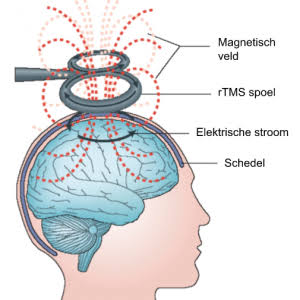
Repetitive Transcranial Magnetic Stimulation (rTMS) is a non-invasive procedure that uses electromagnetic pulses to stimulate nerve cells in targeted areas of the brain.
A rapidly changing electric current in the r-TMS coil generates a magnetic field, which passes painlessly through the skull and induces an electric current in the targeted cortex. This induced current reaches threshold, it depolarizes neurons, triggering an action potential. This electrical signal travels along the neuron, leading to neurotransmitter release and communication with connected neurons.
But the therapeutic effects of r-TMS go far beyond generating action potentials.
Repeated stimulation modifies cortical excitability and promotes synaptic plasticity. This helps to the brain’s ability to reorganize itself.
Where High-frequency r-TMS generally increases cortical excitability through mechanisms resembling Long-Term Potentiation (LTP). And Low-frequency rTMS generally reduces cortical excitability via processes similar to Long-Term Depression (LTD).
Most importantly, r-TMS is network modulation rather than focal stimulation.
Every cortical region is part of larger functional brain networks. Modulating one carefully selected node influences connected regions through structural and functional connectivity. This explains why stimulating the motor cortex can improve motor recovery after stroke, while targeting the dorsolateral prefrontal cortex can influence cognitive and emotional networks in depression.
The future of r-TMS lies in precision neuromodulation—using connectomics and individualized brain network mapping to identify the optimal target for each patient.
The goal is no longer simply to stimulate, but rather to determine which dysfunctional network should be modulated to restore normal brain function.
